Tutorial: Simple game with HTML5 Canvas
Part 1 - Introduction & Background
Part 2 - Character & Animation
Part 3 - Physics & Controls
Part 4 - Platforms & Collisions
Part 5 - Scrolling & Game States
If you are interested in news and updates of that tutorial just follow me on twitter: [MichalBe's Twitter]
Because 10KApart is closed now, and we are all waiting for the results, it is good time to remind my very simple "Stairs to heaven" game and explain in details how it was made.
INTRODUCTION
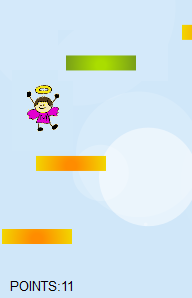 StH is very simple clone of Doodle Jump, but to be honest I was inspired by Icy Tower and discover DJ after I submit StH to the competition. Never mind.
The goal is to control little angel & jump on the two kinds of platforms - orange (regular ones) and green (super high jump springboards). The game ends when the angel falls down to the bottom of the screen. Try it: [Stairs to heaven].
I create that game in about 8hours and later, after playing more and more, I discover few bugs so in this tutorial I want to fix it all. Let's do it!
Part 1. BACKGROUND
Because whole game, including images and scripts, couldn't be over 10K, I didn't want to use image on the background. It was cheaper to draw some generic-like stuff using canvas drawing functions.
First of all we need little HTML, nothing special, just one canvas element with some unique id, little bit of CSS and include of not existing yet game.js:
<html>
  <head>
    <title>Simple game with HTML5 Canvas</title>
  <style>
  body {
    margin:0px;
    padding:0px;
    text-align:center;
  }

  canvas{
    outline:0;
    border:1px solid #000;
    margin-left: auto;
    margin-right: auto;
  }
  </style>
  </head>
  <body>
    <canvas id='c'></canvas>
    <script src="game.js"></script>
  </body>
</html>
That's all in HTML we will need during this tutorial.Ok, so let's create some Javascript.
First of all we need to create few global (for now, I know that global = evil) variables & change canvas attributes. That will be enough:
var width = 320,
//width of the canvas
  height = 500,
//height of the canvas

  c = document.getElementById('c'),
//canvas itself

  ctx = c.getContext('2d');
//and two-dimensional graphic context of the
//canvas, the only one supported by all
//browsers for now

c.width = width;
c.height = height;
//setting canvas size
First of all its important to understand one thing about canvas - it is not possible to move objects in the canvas surface. It's necessarily to clear it, whole or in the parts, on each frame. To achieve this, let's create clear() function. var clear = function(){
ctx.fillStyle = '#d0e7f9';
//set active color to #d0e... (nice blue)
//UPDATE - as 'Ped7g' noticed - using clearRect() in here is useless, we cover whole surface of the canvas with blue rectangle two lines below. I just forget to remove that line
//ctx.clearRect(0, 0, width, height);
//clear whole surface
ctx.beginPath();
//start drawing
ctx.rect(0, 0, width, height);
//draw rectangle from point (0, 0) to
//(width, height) covering whole canvas
ctx.closePath();
//end drawing
ctx.fill();
//fill rectangle with active
//color selected before
}One colored clear background is boring as hell, so let's draw some clouds on it. Maybe not regular clouds, but simple, semitransparent circles imitating clouds. First we will draw some in random places of the canvas, each with different size and transparency. We will keep all the informations about circles in 2d array (there are no two-dimensional arrays in JS, best way to solve this is just put one Array into another). var howManyCircles = 10, circles = [];
for (var i = 0; i < howManyCircles; i++)
circles.push([Math.random() * width, Math.random() * height, Math.random() * 100, Math.random() / 2]);
//add information about circles into
//the 'circles' Array. It is x & y positions,
//radius from 0-100 and transparency
//from 0-0.5 (0 is invisible, 1 no transparency)
var DrawCircles = function(){
for (var i = 0; i < howManyCircles; i++) {
ctx.fillStyle = 'rgba(255, 255, 255, ' + circles[i][3] + ')';
//white color with transparency in rgba
ctx.beginPath();
ctx.arc(circles[i][0], circles[i][1], circles[i][2], 0, Math.PI * 2, true);
//arc(x, y, radius, startAngle, endAngle, anticlockwise)
//circle has always PI*2 end angle
ctx.closePath();
ctx.fill();
}
};
Nice, but boring less only a little. Why are the clouds standing still? Lets make a tiny little function with one Number type argument, which moves clouds down given number of pixels, and when particular circle disappears under the canvas, it will moves it on the top with changed position X, radius and transparency:var MoveCircles = function(deltaY){
for (var i = 0; i < howManyCircles; i++) {
if (circles[i][1] - circles[i][2] > height) {
//the circle is under the screen so we change
//informations about it
circles[i][0] = Math.random() * width;
circles[i][2] = Math.random() * 100;
circles[i][1] = 0 - circles[i][2];
circles[i][3] = Math.random() / 2;
} else {
//move circle deltaY pixels down
circles[i][1] += deltaY;
}
}
};Now, last but not least, let's create main game loop and connect everything we create for now in there. Each frame will clear the screen, move circles 5px lower, draw them and after 1/50sec call another frame. I use two setTimeouts except one setInterval, but I'm not pretty sure why:). I know that there was some performance issues in IE back in the days or something.
Also don't forget to add gLoop variable to that declared at the beginning.var width = 320,
//width of the canvas
height = 500,
//height of the canvas
gLoop,
(...) //rest of the code goes here
var GameLoop = function(){
clear();
MoveCircles(5);
DrawCircles();
gLoop = setTimeout(GameLoop, 1000 / 50);
}
GameLoop();According to Luis Giribone's comment below, I avoid Intervals and use Timeouts instead intentionally - Interval is called every 1000/fps seconds - even if the previous one disn't not finished yet. If you use Timeout, it will call another one only after previous was finished. I hope it is clear now.
I also want to thanks Ped7g, author of Whiskas & Pedigree Javascript ad game for catching mistakes.
Final result of that part should looks like this: [Simple game with HTML5 Canvas part 1], and sources are available on my Github account: [MichalBe]
Tutorial: Simple game with HTML5 Canvas
Part 1 - Introduction & Background
Part 2 - Character & Animation
Part 3 - Physics & Controls
Part 4 - Platforms & Collisions
Part 5 - Scrolling & Game States

You are the man! Thanks for posting this great series!
ReplyDeleteExcellent tutorial! I am doing game-coding tutorials for some 10 years by now, and it's one of the most thorough, and well written! Many Thanks!
ReplyDeleteP.S. Post Part 5 (The Scroll) - I beg You!
Great article, thanks for posting this! I've definitely learned quite a bit, and I plan to follow along.
ReplyDeleteThanks again!
This is just great, really like how you broke it down. I'll be having a go myself for sure!
ReplyDeletewhy do you do "ctx.clearRect(0, 0, width, height);" to clear whole surface, when you fill up whole by blue just after that (i.e. clearing it twice effectively)
ReplyDeleteDoes it solve some browser quirk? (tried to patch it here for ff3.6, works OK without the clearRect)
ck ck ck...
ReplyDeletecan be used as background ... awesome
thanks for tutor^^
salam from si bloglang anu ganteng kalem tea
Awesome tuts! Thanks for posting.
ReplyDeleteJust wondering, is there any specific reasoning behind you placing your functions within variables?
I find it easier just to write them as functions, but I'm n00by so I don't know if there's logic behind it.
Thanks, nice to hear someone likes it:). You can find useful information about declaring functions for example in here: http://zazaq.com/2010/08/07/javascript-function-declaration-vs-function-expression/
ReplyDeletei made only a simple change to avoid setTimeouts
ReplyDelete// game init obj
var GameLoop = function(){
clear();
moveCircles(5);
drawCircles();
}
//end of code init the game
gLoop = setInterval( GameLoop, 1000/fps );
so i don't set a timeout every GameLoop
and is the same code to clear the interval.
Thanks for the tutorial, great game!
Avoiding Intervals and using Timeouts instead was my point in here - Interval is called every 1000/fps seconds - even if the previous one did not finished yet. If you use Timeout, it will call another one only after previous was finished.
ReplyDeletewow, hard to see that point,
ReplyDeletethanks for the clarification :)
you're welcome, that are tutorials for:)
ReplyDeleteIt doesn't do anything. I copy and pasted it and it didn't work. it just shows a blank box that is the wrong size in my chrome tab.
ReplyDeleteSo you are doing something in the wrong way. Try the code from repo.
ReplyDeleteHow can I make the circles move on the x axis instead? :)
ReplyDeleteThanks. I got it working now. Now I'm just trying to understand some of the code that I wrote here and why it works the way it does.
ReplyDeleteOn the circles.push([]) why does it have the [] inside the () of the push?
ReplyDeleteHow do we make the clouds go different speeds between like 1 and 10?
ReplyDeleteprovide different deltaY
ReplyDeleteI mean how do you make each cloud have it's own individual speed? Like one like would go 5px the other would go 10px for example.
ReplyDeletethe answer is still the same - each cloud should have its own deltaY
ReplyDeleteI see. This code thing is sooooo logical.
ReplyDeleteExcellent tutorial! Everything works and it's perfect for a beginner with Canvas/JS.
ReplyDeleteOne question - is there any reason you put comments under your statements? It was just slightly difficult to read for me, that's all.
It's a useful tutorial!!!
ReplyDeleteBut just want to ask what is the usage for the game.js?You didn't mention it.
You have to put all the javaScript code inside this file.
ReplyDeleteOh I see, thanks!!
ReplyDeleteBut I just see the source code in your example, all the javaScript code put in the HTML file but not the game.js?
Check github:
ReplyDeletehttps://github.com/michalbe/Simple-game-with-HTML5-Canvas
everything is in .js file.
Thanx man. First for your great tutorial, second for jsbin :).
ReplyDeleteim pretty sure i did everything right, but i only get a blue screen and no clouds. Any suggestions?
ReplyDeleteSame here. I dont see any cloud either.
Deletefixed it
ReplyDeleteWhy do you make functions using var and not
ReplyDeletefunction funcname()?
Thanks for this great introduction to game development using HTML5 canvas, I managed to create this game after reading your post ! :)
ReplyDeletehttp://ole.im/tetris
Great tutorials thanks html 5 games coding so simple than flash games
ReplyDeleteThanks for your tutorial. I learned lots from here like a e-book. Keep up your work.
ReplyDeleteWonderful training cheers html page Five video games code consequently straightforward as compared to thumb games.
ReplyDeleteThanks for the great tutorial. I really think that HTML5 will prove to be the future of online games and am excited to see what all the developers there will do with the technology.
ReplyDeleteThis comment has been removed by the author.
ReplyDeleteThis is a great tutorial.
ReplyDeleteFor the ones interested in this subject, I've created two premium courses in Udemy:
http://www.udemy.com/html5-game-development
http://www.udemy.com/create-a-html5-game-from-scratch/
yes this is a great tutorial. and thanks FariAzz for link, this is a helpfull. thanks
DeleteI may be missing something because it is not working for me, any idea=?
ReplyDeleteThanks for this awesome tutorial, I just finished this first step without any issues, it was also well explained :)
ReplyDeletethanks for this html5 tutorial, thanks for sharing.
ReplyDeleteThanks for sharing.
ReplyDeleteI just finished this game.
This's game: ungdungdohoa.com/demo/rabbit
another good tutorial
ReplyDeletehttp://www.binarytides.com/make-html5-game-box2d-javascript-tutorial/
I had a goal to learn how to make a game for web in one night. You sir have made that possible, thank you ^.^
ReplyDeleteMy code isn't working. I just see a blue screen, but no clouds. Please help. I even copied the code, but it's not working.
ReplyDeleteAnd how do you think I can help you without the code?
DeleteThis was the only way I could get the clouds to work and stuff. But it's only placing one cloud at a time. I had to change a couple of things to get it to work, but the forloop for Draw Circles isn't working ('cause I should see at least 10 circles, I think, at a time).
Deletewindow.onload = GameLoop;
var width = 320
var height = 500
var c = document.getElementById('c');
var ctx = c.getContext('2d');
function clear() {
ctx.fillStyle = "#5A89CF";
ctx.beginPath();
ctx.fillRect(0, 0, 320, 500);
ctx.closePath();
}
var howManyCircles = 10, circles = [Math.random() * width, Math.random() * height, Math.random() * 100, Math.random() / 2];
function DrawCircles(){
for (var i = 0; i < howManyCircles; i++){
ctx.fillStyle = "rgba(255, 255, 255, 0.5)";
ctx.beginPath();
ctx.arc(circles[0], circles[1], circles[2], 0, Math.PI * 2, true);
// arc(x, y, radius, startAngle, endAngle(full circle), anticlockwise(true);
ctx.closePath();
ctx.fill();
}
};
function MoveCircles(deltaY){
for (var i = 0; i < howManyCircles; i++) {
if(circles[1] - circles[2] > height){
circles[0] = Math.random() * width;
circles[2] = Math.random() * 100;
circles [1] = 0 - circles[2];
circles[3] = Math.random() / 2;
} else {
circles[1] += deltaY;
}
}
};
function GameLoop(){
clear();
MoveCircles(1);
DrawCircles();
gLoop = setTimeout(GameLoop, 1000/50);
}
Uche, did you manage to get everything working?
ReplyDeleteHI, lovely tutorial, Anybody know how to get this game controls to work on a mobile device
ReplyDeleteI've changed the onmousemove to ontouchmove but it only moves the character one way, and not the other any ideas?
thanks
Hey,
DeleteIt should work without any modifications.
Cheers.
thanks for reply, sorry I should have been more clear, Im using cocoonJS to build this game as native on mobile which works brilliantly! but its the controls that don't work :[
Deletehey, thank for great toturial, maybey you want create ebook or pdf with this tots? i want to create mmo rpg free game and this will be good start an motivation ;)
ReplyDeleteSo where exactly would you put the javascript, after you put the tag or inside the html coding
ReplyDeleteAwesome, simply awesome!
ReplyDeleteThanks for the post, I have learned few new things from i html5
Do you know where can i find affordable web development in the philippines
ReplyDeleteHi,
ReplyDeleteThank you so much for this tutorial.
I've been learning Processing.js those days, and I wanted to use it to process a game into a webpage. I've been having a hard time trying to find out how to do it with Wordpress... It turned out to be impossible with my website, so I got pretty frustrated.
So thanks again showing me it's just possible with a simpler method, I think I'll be able to make my game all in HTML5 + JavaScript ant forget about Processing.js for a while ^^
ReplyDeleteGreat Post ! HTML5 tutorial with simple and easy examples, Covering HTML5 Introduction, Semantic Elements,Attributes,Canvas,SVG,Multimedia,Video,Audio,Plug-ins,YouTube Videos, Geolocation, Drag and Drop, Local Storage, Coding Conventions / Style Guide. HTML5 Tutorial & CSS3 Tutorial.
Excellent information with unique content and it is very useful to know about the information based on blogs. Enjoy with the games...
ReplyDeleteplay the best free online flash games
Play the best free online Flash and HTML5 games
magical cat adventure game free online play
car racing games free online play 2015
hi can someone tell me how the file structure works and how they named there files ?
ReplyDeleteI was able to find good information from your blog posts.
ReplyDeleteHTML5 Development
Nice Post Explained everything in detailed and Clearly.If it is possible please share us some html Video Tutorials
ReplyDeleteI had only learned how to do simulations using the R programming language but the three dimension flight simulator is one of a kind and I am looking forward to learning it. I will, therefore, bookmark this site so that I can visit occasionally to learn the simulation skills. Find time and check our professional writing site by clicking on Format my Paper.
ReplyDeleteNice Blog!!!
ReplyDeletePlease check thois link now if you want to play casino online!!!
Thanks!!! GOOD LUCK!!!
บาคาร่าออนไลน์
จีคลับ
Thank you for posting this tutorial in detail with all parts of development. It is easy to learn and useful to a new learner.
ReplyDeleteWoW dude you do great work, the all background file you have posted, It will not help me only but others also. i am happy to come again and see your blog stuff.
ReplyDeleteThankyou very much
Rasakan sensasi permainan yang menakjubkan dan nikmati bonus yang kami sediakan untuk anda .
ReplyDeleteHanya Dengan 1 USER ID anda dapat memainkan 7 GAMES !!
BandarPoker | PokerOnline | CapsaSusun | DominoQQ | BandarQ | AduQ | SAKONG
Mari bermain bersama RUBYQQ , kami Agen Judi Poker Online Terbaik .
HOT PROMO DARI RUBYQQ yang di berikan RUBYQQ untuk para pemain judi poker online yang telah bergabung bersama kami :
☆ Bonus Referral 10% + 10% ( Seumur Hidup )
☆ Bonus Turn Over 0,5% DI BAGIKAN SETIAP HARI !!
☆ NO ROBOT & ADMIN
☆ 100% Fair Play Member Vs Member
☆ Proses Deposit & Withdraw 1-2 Menit .
Untuk informasi lebih lengkap silahkan Hubungi Customer Service kami
BBM : 2B8938F7
FACEBOOK : rubyqq
SKYPE : RUBY QQ
I am thankful to this blog giving unique and helpful knowledge about this topic, I read your blog now share great information here. This blog increse my knowledge source .
ReplyDeleteเรียน igcse ที่ไหนดี
Hey Thanks for adding this post. We have also more than 50 licensed html 5 games. Html5 games, html5 game licesing, Construct 2 games source code and html5 games source code
ReplyDelete
ReplyDeletearticles that are good, see also this interesting article in: bandar togel
very interesting content of this article give inspiration thanks : raja poker
ReplyDeleteGrouptoto yaitu Bandar Togel|Agen Judi Togel Pasaran Togel hongkong Terpercaya – Saat ini kita ke step selanjutnya yakni satu keterangan mengenai Permainan Shio. Permainan Shio yaitu type permainan yang cuma menebak dengan sekumpulan angka-angka yang jatuh pada shio-shio atau simbol spesifik. Bermain shio ini bukanlah bermakna kita bermain dengan tahayul. Pengertian shio ini sesungguhnya begitu simpel dimana kebetulan saja menurut kalender penanggalan Cina kuno, siklus masa kehidupan di muka bumi ini tercermin oleh 12 shio yang berada di muka bumi. Serta dari penjumlahan angka-angka spesifik dari 00 – 99 termasuk juga pada shio-shio itu. Narasi tentang kenapa cuma ada 12 shio ada juga asal usulnya itu. Angka Shio yaitu angka-angka yang telah terdaftar diatas. Ada yang jumlahnya 9 angka, ada yang cuma 8 angka. Jadi tidak seimbang. Tidak sempat ada satu perubahan angka-angka shio. Yang beralih yaitu satu posisi shionya di th. demikian ke th. demikian. Bila th. ini 2011 yaitu th. Kelinci Emas jadi mereka yang lahir pada th. ini 2011 peruntungannya sama juga dengan mereka yang lahir th. 1903, 1915, 1927, 1939, 1951, 1963, 1975, 1987, 1999 itu. Jadi bila kita berikan 1999 + 12 jadi jatuhnya yaitu di th. 2011. Akan tetapi bukanlah 11 nya yang di ambil. Itu tidak punya pengaruh sekalipun. Memahami? permainan shio pada suatu permainan Bandar Togel Terpercaya begitu banyak dimainkan dengan menebak angka serta nomor shio dari angka 1 s/d angka 12 dengan semasing menebak seperti angka usia yang berada di dalam permainan shio itu.
ReplyDeletePermainan Agen Togel Terpercaya serta Bandar Togel Online dengan menebak shio yaitu menebak kurang lebih angka apa yang juga akan keluar pada Pasaran Togel Hongkong atau Togel Singapura serta jatuh pada suatu shio itu. Contoh : bila permainan Agen Togel Online di hari Senin ini keluar dengan angka 2015, jadi bermakna juga akan jatuh ke shio Kelinci. Yang kita ambillah yaitu dengan susunan 2D-nya seperti kepala serta ekor yaitu : 15. Pemain yang menempatkan shio Kelinci jadi mereka juga akan menang serta juga akan memperoleh hadiah dari Agen Togel serta Bandar Togel yang mereka mainkan. Contoh beda ada juga Katakanlah pada suatu angka Togel On-line sore kelak yang keluar 2835. Ini bermakna keluar dengan permainan Shio Babi. Karna angka 35 ada di grup angka-angka Shio Babi itu. Memahami? Jadi permainan shio dalam permainan Togel On-line yang sesungguhnya yaitu dengan menebak beberapa angka dengan Live Number. Cuma saja lebih seru karna dapat mencermati permainan Shio itu dengan hasil yang juga akan di keluarkan. Cobalah Anda saksikan serta tekuni sekali lagi kalau permainan shio-shio ini ada titik celahnya yang seringkali dimaksud dengan satu plus minus 12. Kelak juga akan kita ulas selanjutnya yang berada di celah-celah angka permainan Togel Online. Mungkin saja bila Anda sukai bermain didalam satu permainan Shio-Shio jadi cobalah saksikan pada suatu alur binatang-binatang yang ada mungkin saja ada hubungan namun bermainlah didalam satu tehnik yang semakin banyak didalam satu alur Live Number atau pada suatu Angka Mati. Bukanlah main di shio namun di permainan 4D. Cuma saja kita pakai shio jadi tehnik untuk dapat bisa memotong nomor. Anda dapat cobanya bermain didalam permainan shio etrsebut untuk dapat memperoleh satu keuntungan yang begitu besar didalam bermain permainan itu persisnya anda bermain didalam satu Agen Togel On-line yang terpercaya pastinya.
ReplyDeletewant to read this interesting article for this month immediately click my article and get a great experience after reading my article on:
poker online betting
want to read this interesting article for this month immediately click my article and get a great experience after reading my article on:
ReplyDeleteBandar togel Hongkong
very interesting content of this article give inspiration thanks dewa poker
ReplyDelete
ReplyDeletewant to read this interesting article for this month immediately click my article and get a great experience after reading my article on:
bandar Togel sgp yang paling aman
want to read this interesting article for this month immediately click my article and get a great experience after reading my article on:
ReplyDeletebandar judi poker online yang paling aman
ReplyDeletegood artikel , i really like you artikel, pleas klik my artickey add Bandar togel Hongkong
ReplyDeletevery good article, do not forget to visit other interesting articles at: berita terbaru
Marketing Guides
ReplyDeleteJavaScript App
All watched up
Everyday snipps
Freezerfree - free app and games to download for andorid
gaiascout
Learn german today
Free blogger seo template
the ma maxi is here
javaScript to do applications
Owner
ReplyDeleteThank you for sharing valuable information.
สมัคร Sbobet
365mimpi Bandar Togel Online dan Agen Togel Terpercaya dengan Pasaran Togel Online Terlengkap, Togel Singapura, Togel Hongkong, dengan Result Togel Online Live
ReplyDeleteAgen Togel
Togel Singapore
Bandar Togel
Judi Togel
Togel Terpercaya
Togel Sydney
Togel USA
Togel Hongkong
Agen Togel Terpercaya
Togel Macau
Situs Togel
Togel Online
Togel Filipina
Daftar 365Mimpi
365Mimpi
very good this article I really like the article you publish thanks.
ReplyDeletetogel sgp
i love reading this article so beautiful!!great job!
ReplyDeletehttp://gainfreestuff.com/
I really like the article in this block is short but interesting to understand.
ReplyDeletetogel online
Thank you.
ReplyDeletejoker gaming
Scr888
ace333
I really like this article is really simple but this is amazingly good
ReplyDeletetogel sgp
HTML5 is the highest new version of hypertext markup language. In this release also provided to the user some APIs that support drawing objects easily such as: Canvas, SVG and WebGL.
ReplyDeleteVietnamese hair
Vietnam hair
Pengen nonton film online cuma di sukabioskop.com
ReplyDeleteThank you for good content. For the choice of investment.
ReplyDeletelsm99
SAHABATPOOLS adalah Situs Taruhan Togel Online Terpercaya yang sangat berpengalaman dalam judi togel online serta banyak diplih oleh agen darat dan para pecinta judi togel online di Indonesia. Sahabatpools.io menyediakan pasaran untuk Taruhan Togel SGP / Singapore , Togel Sydney, Togel HK / Hongkong Terpercaya, Bangkok, Praha, Kyoto & Gangnam.
ReplyDeletewww.Sahabatpools.io juga memberikan kemudahan bagi pecinta togel online untuk mengakses situs ini dari via mobile / handphone WAP serta staf profesional yang memberikan pelayanan 24 jam setiap harinya. Sahabatpools.io juga bisa membantu dalam membuat Akun Togel Online dan Daftar Akun Togel. sahabatpools.io juga menjamin keamanan akun togel member dan memberikan kenyamanan serta kemudahan transaksi, sahabatpools memberikan bukti bukan hanya sekedar janji.
Sahabatpools.io Memberikan bonus cashback sampai 2% - 5% dan Bonus Referal dari 1% - 2%, jadi tunggu apa lagi mari bergabung bersama agen darat lain nya dan dapatkan semua promo nya, tidak hanya itu saja jika bermain di www.sahabatpools.io anda tidak perlu pusing akan limit bet dan batas line karna di sahabatpools.io semua nya bebas, dan kami juga akan mendangar jika ada keluahan dari anda biar kami bisa memperbaiki nya dan akan buat anda nyaman dan aman. Keluhan SERTA kenyaman anda bermain adalah MOTTO dari Sahabatpools.io
Transaksi deposit & withdraw aman, mudah, cepat dan terpercaya.
VIA BANK BCA-BNI-BRI-MANDIRI.
Untuk lebih jelasnya silahkan hubungi :
WA : +66656407677
PIN BBM : D8627CB6
ID LINE : sahabatpools.com
https://g.co/kgs/GGvnG8
Deletehttps://bateraitanam.blogspot.com
https://bimbellampung.blogspot.com
lampungservice.com
well! Thanks for providing a good stuff related to DevOps Explination is good, nice Article
ReplyDeleteanyone want to learn advance devops tools or devops online training
DevOps Online Training
DevOps Online Training hyderabad
This is great.. I really like the way of your explanation.. Thanks for sharing..
ReplyDeleteDevOps Online Training
This is nice post.
ReplyDeletedaftar akun poker
poker deposit pulsa
bandar ceme
situs taruhan togel
prediksi togel sgp
agen maxbet online
bola deposit pulsa
angka main togel
thank you for sharing
ReplyDeleteprediksi sgp
bandar ceme
This site has a very interesting article
ReplyDeleteberita bola terlengkap
poker deposit pulsa
idnplay poker
bola deposit pulsa
มาเด้ เป็นอย่างไร? เป็นส่วนประกอบของสารสกัดที่มาจากธรรมชาติมีทั้งยังวิตามินรวม ธาตุ เอนเหล้าองุ่นแล้วก็เชลล์บรรเทา
ReplyDeleteมีทั้งยังพลาสเซนต้าและก็คอลลาเจนโดนสารทั้งหมดจำเป็นจะต้องผ่านขั้นตอนตระเตรียมสูตรยาแบบ(Homeopathy)
เป็นศาสตร์การบำบัดที่มีต้นกำเนิดมาจาก สหพันธ์สาธารณรัฐเยอรมนี โดยกานศึกษาและทำการค้นพบของแพทย์ ซามุเอลฮาเนมัน แก่มากยิ่งกว่า 200
ปีโดยมีวิธีการบรรเทาว่า (ใช้สิ่งที่คล้ายคลึงกันมารักษาสิ่งที่คล้ายคลึงกัน) หรือการนำเอาสารที่เป็นต้นเหตุของอาการนั้นๆ
มาเด้
มาเด้ หน้าใส
ฉีดมาเด้ ที่ไหนดี
Nice article!!!
ReplyDeleteThank you for sharing
Thank you for valuable article,
ReplyDeleteWaiting for new articles and more info!!!
Well written post. I appreciate your guidance for sharing about Windows Azure . I really need to know about it. Great work!
ReplyDeleteBlockchain Training in Hyderabad
daftar akun poker
ReplyDeletecapsa susun
bandar ceme
promo fordpoker
poker deposit pulsa
Which is the best training institute for PLC, SCADA, and DCS, and where is it located in India?
ReplyDeleteLIVEWIRE is in association with 250+ corporates, who grab candidates from our centres when they match their job requirement. We offer all these opening to the students.Get trained through an ISO certified institute. Our course completion certificate and material are globally recognized. If you want to more details contact us: #LivewireVelachery, #PLCTraininginChennai,#PLCTrainingInstituteinChennai,#PLCTraininginVelachery, 9384409662
a very useful website, very good to always remember and must be taken care of thanks for the information.
ReplyDeleteBisnis Kuliner Online
Bisnis Online Indonesia
I am not very good at writing, after I saw this very good website, I became excited to write smarter.
ReplyDeletePerawatn Kacer Untuk Lomba
Pecinta Burung
Thank you for info!
ReplyDeleteVery Useful
Great delivery. Outstanding arguments. Keep up the great spirit.
ReplyDeleteManfaat memancing
Pecinta mancing
This article is very interesting, thank you
ReplyDeleteBandar Poker Terbaik
Alternatif Judi Togel
Alternatif Judi Terbaik
Alternatif Judi Poker
Alternatif Judi Bola
Situs Poker Terbaik
Link Poker Terpercaya
Thank u for this information
ReplyDeletehttp://www.mistltd.com
As technology grows, we have to be updated in our domain to sustain in the IT industry. Your post made
ReplyDeleteme impressed in the way of your writing.
The article on this site is very interesting, thank you
ReplyDeleteLogin Judi
Situs Judi
Link Judi
Agen Judi
Bandar Judi
The article on this site is very interesting, thank you
ReplyDeleteSelamat datang di LENOVOPOKER ™ Top 1 Judi Online
Promo Terbaru LENOVOPOKER :
- Bonus New Member Depo +20%
- Bonus All Member Next Depo +5%
- Bonus All Member Refferal 30%
- Bonus All Member Rollingan 0.5%
Contact : BBM : LENOVO88
WA : +6281375260652
Agen Domino 99
Bandar Poker
Agen Ceme
Bandar Ceme
Judi Poker Terpercaya
ReplyDeletei'm Here to Get Great About DevOps, Thanks For Sharing
DevOps Training
DevOps Training in Ameerpet
DevOps Training institute in Hyderabad
Awesome write-up
ReplyDeleteinteresting articles and this is my first first reading a very interesting
AGENTANGKASONLINE
judi tangkas
Agen Tangkas
thanks for Providing a Good Information
ReplyDeleteanyone want to learn advance devops tools or devops online training visit:
DevOps Training
DevOps Online Training
DevOps Training institute in Hyderabad
Really great post, Thank you for sharing This knowledge.Excellently written article, if only all bloggers offered the same level of content as you, the internet would be a much better place. Please keep it up!
ReplyDeleteAWS Training in pune
AWS Online Training
Its really an Excellent post. I just stumbled upon your blog and wanted to say that I have really enjoyed reading your blog. Thanks for sharing....
ReplyDeleteAWS Training in Bangalore
AWS training in sholinganallur
AWS training in Tambaram
AWS training in Velachery
ReplyDeleteVietnam hair
Vietnamese hair
Vietnam remy hair
Vietnam human hair
Vietnam virgin hair
Vietnam real hair
This comment has been removed by the author.
ReplyDeleteThis comment has been removed by the author.
ReplyDeleteGreat Article. Thanks for sharing info.
ReplyDeleteDigital Marketing Course in
Hyderabad
Digital Marketing Training in Hyderabad
AWS
Training in Hyderabad
SEO Training in Hyderabad
ReplyDeleteGreat Article. Thanks for sharing info.
SEO Training in Hyderabad
Online Digital Marketing Courses in Hyderabad
Adwords Training in Hyderabad
Social Media Marketing Training in Hyderabad
Google Analytics Training in Hyderabad
Great Article. Thanks for sharing info.
ReplyDeleteIELTS Coaching in Hyderabad
ServiceNow Training in Hyderabad
SharePoint Training in Hyderabad
Tableau Training in Hyderabad
SAP FICO Training in Hyderabad
Great Article. Thanks for sharing info.
ReplyDeleteSAP ABAP Training in Hyderabad
SAP FICO Training in Hyderabad
AWS Training in Hyderabad
Salesforce Training in Hyderabad
Selenium Training in Hyderabad
The best forum that I have never seen before with useful content and very informative.
ReplyDelete[url=https://digitalfloats.com]Digital Marketing Course in Hyderabad[/url]
[url=https://digitalfloats.com]Digital Marketing Course in Hyderabad[/url]
[url=https://digitalfloats.com]Digital Marketing Course in Hyderabad[/url]
[url=https://digitalfloats.com]Digital Marketing Course in Hyderabad[/url]
[url=https://digitalfloats.com]Digital Marketing Course in Hyderabad[/url]
The best forum that I have never seen before with useful content and very informative.
[url=https://digitalfloats.com]Digital Marketing Course in Hyderabad[/url]
[url=https://digitalfloats.com]Digital Marketing Course in Hyderabad[/url]
[url=https://digitalfloats.com]Digital Marketing Course in Hyderabad[/url]
[url=https://digitalfloats.com]Digital Marketing Course in Hyderabad[/url]
[url=https://digitalfloats.com]Digital Marketing Course in Hyderabad[/url]
The best forum that I have never seen before with useful content and very informative.
ReplyDelete[url=https://digitalfloats.com]Digital Marketing Course in Hyderabad[/url]
[url=https://digitalfloats.com]Digital Marketing Course in Hyderabad[/url]
[url=https://digitalfloats.com]Digital Marketing Course in Hyderabad[/url]
[url=https://digitalfloats.com]Digital Marketing Course in Hyderabad[/url]
[url=https://digitalfloats.com]Digital Marketing Course in Hyderabad[/url]
Roulette Online Terpercaya
ReplyDeleteLink Situs Judi
Situs Judi Onlin
Bandar Togel Terpercaya
AngularJs Training in Bhopal
ReplyDeleteCloud Computing Training in Bhopal
PHP Training in Bhopal
Graphic designing training in bhopal
Python Training in Bhopal
Android Training in Bhopal
Machine Learning Training in BhopalAngularJs Training in Bhopal
Cloud Computing Training in Bhopal
PHP Training in Bhopal
Graphic designing training in bhopal
Python Training in Bhopal
Android Training in Bhopal
Machine Learning Training in Bhopal
HTML interview questions. interview answers
ReplyDeleteGreat Article. Thanks for sharing info.
ReplyDeleteDigital Marketing Course in Hyderabad
Digital Marketing Training in Hyderabad
AWS Training in Hyderabad
Workday Training in Hyderabad
Salesforce Training in Hyderabad
SAP FICO Training in Hyderabad
SAP ABAP Training in Hyderabad
Awesome.
ReplyDeleteaws training in hyderabad
Good informative post.
ReplyDeleteaws training in hyderabad
Hi, saya donny. Saya mau kenalin Situs Judi Agen BandarQ Terbaik di Indonesia. Kunjungi situsnya di http://ligaqq.online/
ReplyDeletevery informative blog and useful article thank you for sharing with us , keep posting learn more about aws with cloud computing, AWS Online Training
ReplyDeleteIts very informative blog and useful article thank you for sharing with us , keep posting learn
ReplyDeleteData Science online Course
dot NET Course
I love reading your articles. Thank you very much. Write more.
ReplyDeleteVery useful information for people, I think this is what everyone needs.
ReplyDeleteThis comment has been removed by the author.
ReplyDeleteThe data that you provided in the blog is informative and effective.Thank you for sharing the article.
ReplyDeleteBest HTML5 Training Institute
STEPSBOBET เว็บแทงบอลออนไลน์ คาสิโนออนไลน์ ที่ดีที่สุดอันดับ 1 สมัคร sbobet แทงบอลสเต็ป กีฬาออนไลน์ บาคาร่าออนไลน์ สล็อตออนไลน์ ครบวงจร ให้บริการเดิมพันออนไลน์ทุกประเภท มีความน่าเชื่อถือ
ReplyDeleteเว็บแทงบอลออนไลน์อันดับ 1
สมัคร sbobet
สมัคร Lsm99
สมัคร Sclub
สมัคร Ace333
สมัคร League88 ลีค88
สมัคร Gclub
สมัคร King99
This comment has been removed by the author.
ReplyDeleteVery informative blog and useful article thank you for sharing with us, keep posting learn more about aws with cloud computing
ReplyDeleteAWS Online Training
AWS Certification Training
AWS Training and Certification
Amazon Web Services Training
AWS Training
AWS Course
AWS Training in Bangalore
AWS Certification
Good job and thanks for sharing such a good blog You’re doing a great job. Keep it up !!
ReplyDeletePMP Certification Fees | Best PMP Training in Chennai |
pmp certification cost in chennai | PMP Certification Training Institutes in Velachery |
pmp certification courses and books | PMP Certification requirements |
PMP Training Centers in Chennai | PMP Certification Requirements | PMP Interview Questions and Answers
I really like this article is really simple but this is amazingly good
ReplyDeleteAbinitio Online Training
Ab initio Interview Questions and Answers
Active Directory Online Training
Active Directory Interview Questions and Answers
Nice Blog!
ReplyDeleteSailpoint Online Training
been using only mobile apps for everything www.lampungservice.com
ReplyDeletehttps://komunitasyoutuberindonesia.wordpress.com
https://youtuberandroid.wordpress.com
https://youtuberterbaikindonesia.wordpress.com
https://jasalogoiklan.wordpress.com/
https://lampungcenter.wordpress.com
https://jasaiklanbarisonline.wordpress.com
https://usahabisnistokoonline.wordpress.com/
https://indonesianservices.wordpress.com
https://jasapengetikandibandarlampung.blogspot.com/
https://servicecenteriphone.blogspot.com/ http://www.lampungservice.com
ReplyDeletehttps://kursusteknisiservicehp.blogspot.com/https://jskursus.blogspot.com/https://kursusservicehplampung.blogspot.com/
https://jasaserviceteknisi.blogspot.com/https://jasaeditfotobandarlampung.blogspot.com/https://sevicecenterhimax.blogspot.com/https://servicecenteradvan.blogspot.com/
https://jasapengetikandibandarlampung.blogspot.com/
TT4D | TOGEL TERPERCAYA | AGEN TOGEL ONLINE TERPERCAYA
ReplyDeleteAgen Togel Online Terpercaya Dengan Fiture-fiture Terbaik sebagai berikut :
• BBFS Sampai 10 Digit
• Hadiah Prize 4D dan 3D Semua Pasaran
• Tersedia Live Games dan Sbobet Bola atau Casino
• Bonus Referral Sebesar 0,5% dari Semua Pemasangan Seumur Hidup
• Lomba Dengan Hadiah Jutaan Rupiah dan Juga Lomba GRATIS SALDO 5.000 / Pasaran Setiap Hari
Hadiah & Diskon TT4D TOGEL TERPERCAYA :
• HADIAH 4D x 3.000 ( 65% )
• HADIAH 3D x 400 ( 59% )
• HADIAH 2D x 70 ( 29% )
Hadiah Hiburan Jackpot 4D & 3D Semua Pasaran :
Prize I : x 3 Juta ( 4D ) | x 400 Ribu ( 3D )
Prize II : 200 Ribu ( 4D ) | 20 Ribu ( 3D )
Prize III : 100 Ribu ( 4D ) | 10 Ribu ( 3D )
Started Prize : 55 Ribu ( Hanya 4D )
Consolation : 25 Ribu ( Hanya 4D )
Pasaran Tutup Terlama TT4D Togel Terpercaya :
• Vietnam Tutup Jam 11.00 WIB dan Result Jam 11.30 WIB
• Sydney Tutup Jam 13.30 WIB dan Result Jam 13.50 WIB
• Las Vegas Tutup Jam 15.30 WIB dan Result Jam 16.00 WIB
• Singapore Tutup Jam 17.25 WIB dan Result Jam 17.45 WIB
• Lemacau Tutup Jam 19.30 WIB dan Result Jam 20.00 WIB
• Hongkong Tutup Jam 22.40 WIB dan Result Jam 23.00 WIB
Website Login / Daftar TT4D:
• TT4D.VIP
Kontak Official :
- Pin BBM : TT4DOK
- WA : +855963240368
This comment has been removed by the author.
ReplyDelete
ReplyDeleteGreat Article. Thanks for sharing info.
https://www.exltech.in/java-training.html
This concept is a good way to enhance the knowledge.thanks for sharing..
ReplyDeleteAngular JS Training in Hyderabad
Angular JS Training in Ameerpet
Angular JS Training
Angular JS Online Training
mix.com/cvlampungservicekingcameranfoundation.ning.com/profiles/blogs/best-indonesian-coursesmedium.com/@lampungservice.comlampung.wikidot.com/main:layout
ReplyDeletelampungservice.comtempatservicehpdibandarlampung.blogspot.com
microformats.org/wiki/vcard-implementations
This is really great informative blog. Keep sharing.
ReplyDeleteGCP Training
Google Cloud Platform Training
GCP Online Training
Google Cloud Platform Training In
Hyderabad
ReplyDeleteThank for sharing very valuable information.nice article.keep posting.For more information visit
aws online training
you have a great blog here! would you like to make some invite posts on my blog?
ReplyDeleteAgen Poker Online Terpercaya
Judi Online
Link alternatif sobatpoker
sobatpoker
If you are fed of searching jobs in Assam - You can check this fresh content at Sarkari Sakori | Sarkari Naukri in UP
ReplyDeleteFor Freejobalert we suggest you to visit freejobalert website
ReplyDeleteExcellent Tutorial
ReplyDeleteThankx alot for the post. i got great code help about HTML 5
ReplyDeleteI really appreciate your article. the post has excellent tips which are useful. this post is good in regards of both knowledge as well as information iTunes Gift Card Codes
ReplyDeleteHey guys I just want to say that I got an official notification that iTunes is providing us free gift cards codes iTunes Gift Card Codes
ReplyDeleteVery nice collection of blog you have shared here I have read your article so informative I liked so much, thank you very much for sharing
ReplyDeleteDigital Marketing Courses In Rohini
Thanks for Sharing this useful information. By SharePoint Development
ReplyDeleteThanks for Sharing this useful information. Get sharepoint apps development from veelead solutions
ReplyDeleteVery Informative Blog
ReplyDeleteFrom
HL7 Online Training In Hyderabad
ReplyDeleteGet the most advanced AWS Course by Professional expert. Just attend a FREE Demo session.
For further details call us @ 9884412301 | 9600112302
AWS training in chennai | AWS training in velachery
Nice post,.. thank you for sharing,.
ReplyDeletePython training in Chennai/
Python training in OMR/
Python training in Velachery/
Python certification training in Chennai/
Python training fees in Chennai/
Python training with placement in Chennai/
Python training in Chennai with Placement/
Python course in Chennai/
Python Certification course in Chennai/
Python online training in Chennai/
Python training in Chennai Quora/
Best Python Training in Chennai/
Best Python training in OMR/
Best Python training in Velachery/
Best Python course in Chennai/
Thank you for sharing wonderful information with us to get some idea about it.
ReplyDeleteOpenstack Training
Openstack Certification Training
OpenStack Online Training
Openstack Training Course
Openstack Training in Hyderabad
excellent article
ReplyDeletedata science training in bangalore
Nice article.
ReplyDeleteFor the best python training in bangalore, Visit:
Python training in Bangalore
vVisit here=> Big Data And Hadoop Training in Bangalore
ReplyDeleteThanks for sharing.it really helpful.nice information.
ReplyDeleteData science course in pune
Data science classes in pune
Data science training in pune with placement
Data science training in pune
nice article thanks for sharing the post....!
ReplyDeleteSAP ABAP Training
SAP Fico Training
SAP PM Training
SCCM 2012 Training
SCCM 2016 Training
Splunk Admin Training
Splunk Development Training
SAP ABAP Training
ReplyDeleteSAP Fico Training
SAP PM Training
SCCM 2012 Training
SCCM 2016 Training
Splunk Admin Training
Splunk Development Training
Visit here for more about Hadoop training in bangalore -> Big data and hadoop training in bangalore
ReplyDeleteThanks for sharing this info. But updation has come. please update your article.
ReplyDeletelean Six Sigma Green Belt, Black Belt Training and consulting|
lean Six Sigma Green Belt Training at Hyderabad, Chennai|
lean management training|
lean Six Sigma Green Belt, Black Belt Training and consulting|
lean Six Sigma Green Belt, Black Belt Training and consulting
Nice post.
ReplyDeleteamazon web server training institute
android training institute
angular js training institute
appium training institute
application packaging training institute
business analysis online course
cognos training institute
data modeling training institute
One of the Main topic of Web Design ,which we need to know during that time... today i got this blog so thanku so much for sharing this.. i ll share this with new people...
ReplyDelete
ReplyDeleteThanks for sharing this post Very Useful for us...
DevOps Online Training in Hyderabad
DevOps Training Online
Nice infromation
ReplyDeleteSelenium Training In Chennai
Selenium course in chennai
Selenium Training
Selenium Training institute In Chennai
Best Selenium Training in chennai
Selenium Training In Chennai
Rpa Training in Chennai
Rpa Course in Chennai
Rpa training institute in Chennai
Best Rpa Course in Chennai
uipath Training in Chennai
Blue prism training in Chennai
Nice blog......!
ReplyDeletehyperion planning online training
hyperion financial management online training
hyperion smartview online training
quality analysis qa online training
Thank you for sharing wonderful information with us to get some idea about that content. check it once through
ReplyDeleteGoogle Cloud Platform Training
GCP Online Training
nice share thank,visit my web
ReplyDeleteSakuratogel adalah situs bandar togel singapore terbaik dan terpercaya yang memberikan kenyamanan kepada para member pecinta togel online atau singapore prize,sakuratogel juga memanjakan member nya dengan memberikan bonus deposit setiap hari nya,dan bukan hanya itu saja,diskon dan hadiah paling tinggi.
ayo bergabung sekarang juga bersama sakuratogel,klik link dibawah ini :
http://sakuratogel.xyz/
Nice blog.......!
ReplyDeletewise package studio training
installshield training
linux admin training
microsoft ssas training
Thanks for your valuable post... The data which you have shared is more informative for us...
ReplyDeleteaws Training in Bangalore
python Training in Bangalore
hadoop Training in Bangalore
angular js Training in Bangalore
bigdata analytics Training in Bangalore
This comment has been removed by the author.
ReplyDelete
ReplyDeleteIt’s awesome that you want to share those tips with us. I assume lot of us that commented on this post are just starting to search for different ways of blog promotion and this sounds promising. This is definitely the article that I will try to follow when I comment on others blogs. Cheers
Data Science Training in Hyderabad
Hadoop Training in Hyderabad
Java Training in Hyderabad
Python online Training in Hyderabad
Tableau online Training in Hyderabad
Blockchain online Training in Hyderabad
informatica online Training in Hyderabad
devops online Training
ReplyDeleteData Science Training in Hyderabad
Hadoop Training in Hyderabad
Java Training in Hyderabad
Python online Training in Hyderabad
Tableau online Training in Hyderabad
Blockchain online Training in Hyderabad
informatica online Training in Hyderabad
devops online Training
Really great blog…. Thanks for your information. Waiting for your new updates.
ReplyDeleteaws Training in Bangalore
python Training in Bangalore
hadoop Training in Bangalore
angular js Training in Bangalore
bigdata analytics Training in Bangalore
python Training in Bangalore
aws Training in Bangalore
Awesome article, Digital marketing tools
ReplyDeleteThanks for sharing such a nice informaion.
ReplyDeletedigital-marketing-course-in-hyderabad/
digital-marketing-agency-in-hyderabad/
selenium-training-in-hyderabad/
salesforce-training-hyderabad/
microsoft-azure-training-in-hyderabad/
Thanks for sharing the content.It helped us very much.
ReplyDeletedigital-marketing-course-in-hyderabad/
digital-marketing-agency-in-hyderabad/
selenium-training-in-hyderabad/
salesforce-training-hyderabad/
microsoft-azure-training-in-hyderabad/
thanks for Providing a Great Info...
ReplyDeletedigital-marketing-course-in-hyderabad/
digital-marketing-agency-in-hyderabad/
selenium-training-in-hyderabad/
salesforce-training-hyderabad/
microsoft-azure-training-in-hyderabad/
Thanks for provide great informatic and looking beautiful blog
ReplyDeleteThanks for the information. It's very useful. If any one is looking for the best piano teacher in Singapore
great article
http://makeland.link/higaming/
http://mbc1588.cafe24.com
http://makeland.link/crazyslot/
https://mbc1588.cafe24.com
https://bet365kor1.com/
https://ocn2001.com/
This is a great article thanks for sharing this informative information.
ReplyDeleteaws Training in Bangalore
python Training in Bangalore
hadoop Training in Bangalore
angular js Training in Bangalore
bigdata analytics Training in Bangalore
python Training in Bangalore
aws Training in Bangalore
This is an awesome blog. Really very informative and creative contents.
ReplyDeleteaws Training in Bangalore
python Training in Bangalore
hadoop Training in Bangalore
angular js Training in Bangalore
bigdata analytics Training in Bangalore
python Training in Bangalore
aws Training in Bangalore
This is a really an awesome article which will be informative to everyone.
ReplyDeleterpa training institutes in marathahalli
rpa course content
rpa training centres in bangalore
rpa computing course syllabus
rpa training
rpa training in marathahalli
Such a great word which you use in your article and article is amazing knowledge. thank you for sharing it.
ReplyDeleteBest SAP Training in Bangalore
Best SAP ABAP Training in Bangalore
Best SAP FICO Training in Bangalore
Best SAP HANA Training in Bangalore
Best SAP MM Training in Bangalore
Best SAP SD Training in Bangalore
Your Information was very clear.Nice and Informatic Blog Thank you for sharing!!!
ReplyDeleteazure devops training in ameerpet
azure devops online training
Azure devops training