Showing posts with label game. Show all posts

Thursday, May 24, 2012

.getUserMedia puzzle game

During my last talks about Blysk I presented couple of new HTML5 features that are quite new, and were implemented only in Flash before. Access to the webcam was one of the most interesting.
VideoPuzzle on WebRebels:
Michal Budzynski at Web Rebels And since learning by playing is always fun, I made a simple puzzle game that uses webcam to display realtime video on the puzzles. To run it you need Chrome Canary with Media Stream enabled.
I was asked to publish it somewhere so you can find the source code on Github:

.getUserMedia() VideoPuzzle game
or try it now here

Why doesn't it work in Opera with .getUserMedia() support?
I was superlazy writing the code (it took me less than hour, it was just techdemo, not the regular, production code). And the easiest way to determine if the pieces was dropped in the right place was to check if the previously added 'data-order' values of the DOM elements (canvas - piece & div - place in which you put the piece) are equal. I took the second element from event.target argument of mouseup event, and since dragged piece has 'pointer-events' set to 'none'. It should allow the event to go through the piece. Not in Opera. I don't know if it's Opera's or all the other vendors, there's nothing in spec about that.

Monday, May 14, 2012

onGameStart 2012

The most important thing in the life adventure is to remember when and how did it start. First impressions, inspirations and simple steps shape the future.
My gaming experience started in mid '90 on my XT with Hercules graphic card and amber screen. I was too young (and I lived on the other side of the iron curtain) to remember Apple II or Commodore computers before. One of the first games I remember from my early childhood was 'Prince of Persia' made by Jordan Mechner. I played it for almost 12 years before I was able to finish it without cheating (I can still remember 'prince megahit' password that enables cheat mode). I'm sure that a lot of you had similar experience.

What does this have to do with onGameStart?

Earlier this year I tweeted that HTML5 gamedevs are the new generation of game makers, and like every other 'new generation' we reinvent the same patterns or techniques our older friends implemented 30 years ago. There is no better way to learn, than listen to the real experts. That's why Jordan Mechner, creator of Prince of Persia, will share his experience during this year's Main onGameStart Keynote.

During two days of the conference it will be also possible to listen to presentations of the biggest, most talented and most respected HTML5 game developers from all over the world. And differently from last year, we will focus on real HTML5 games, tools that could help you write your own game, and wide variety of services for distribution, payments, statistics, and everything you will need to create great game. No more tech demos or examples - we all know that HTML5 has become mature enough, and players don't care about the technology - they want games. And we need those players and those games to prove that Open Web Technologies can compete with any other technology used in game development.

First part of confirmed speakers list for this year's edition of the first HTML5 game conference:
Seb Lee-Delisle, trainer on CreativeJS workshops
Jerome Etienne, creator of learningthreejs.com and tQuery
Jon Howard, responsible for games for kids in BBC
Andres Pagella, creator of Tracy and author of "Making Isometric Social Real-Time Games with HTML5, CSS3, and JavaScript"
Szymon Pilkowski, former senior JS developer in Crytek & Bigpoint
Robert Podgorski, boss of Black Moon Dev, one of the best pixel artists ever
Jonas Wagner, author of great WebGL demos
And of course last but not least,
Jordan Mechner, creator of Prince of Persia

So about 30 seconds ago we have launched our site, onGameStart.com. And because it's all about gaming, we've simply created a game with outstanding graphics by Robert. Control little astronaut with arrow keys, use space to talk to the speakers (close the window with 'z'), avoid lasers and spikes, and use keycards to open the door. If you don't want to explore our oGS spaceship, you can simply click on the head of the speaker in the top menu, and you will be teleported to the given speaker - you can still talk with him using space. game was created using Dominic's ImpactJS so it should work in most of the browsers. If you happen to find a bug, typo etc, feel free to tweet me about that (@michalbe). Enjoy, and stay tuned (Lanyrd, Facebook & Twitter)! We will announce more speakers and surprises soon.

Wednesday, May 4, 2011

Mibbu - javascript html5 game framework

I have just published initial release of Mibbu - my javascript microframework for fast game prototyping. To be honest - it is just set of functions and patterns I use always when I write my games. It is more a sandbox, starting place with basic tools, than a real framework (that's why I called it 'microframework'). It provides sprite animations, basic operations like movement or collisions, scrolling backgrounds and drawing on both - canvas or DOM. It uses DOM only when it is not possible to use Canvas (like in older IEs), but you can force it to do so with one single function (canvasOff()) - then it will be drawn with divs & imgs. It is the same mechanics I have used in OpenOdyssey or Janpu. I will try to write something more about using Mibbu later this week.

Friday, January 14, 2011

Mozilla Game On 2010

During last Thursday it was possible to send your entry to the Mozilla GameOn 2010 Competition. There were more than 160 games submitted, but some of them was disqualified because of using 'non open' technologies like flash or Unity. Finally, there are 124 chosen titles in the gallery. Checking almost every game I found couple of technologies, libraries, plugins, frameworks or engines I've never heard of before, or just forgot about. Some of them are worth describing in here. First of all I totally forgot about HTML5 Boilerplate, an "HTML/CSS/JS template for a fast, robust and future-proof site", used in Snake game [MGO2010]. Another technically interesting entry was Black Obelisk [MGO2010], written completely in haXe, opensource programming language with ability to compile to Javascript, Flash, NekoVM bytecode, PHP, C++ and C# or Java in the near future. Couple of games was written in Java with cross-compiled JavaScript presentation layer using GWT, eg SVG-EDU [MGO2010] or Zulu [MGO2010]. Main reason people used Flash in their games was enabling sound effects (like Sinuous [MGO2010], the winner of 10kApart). But Wizard Wars [MGO2010] used SoundManager2 to achieve same effect. Mad Tanks TD [MGO2010], one of my personal favorites in the competition, uses LESS, which "extends CSS with variables, mixins, operations and nested rules". Looks cool! (both, the game and the compiler:) ). I was impressed with amount of WebGL based games. In Red shooting Hood [MGO2010], made by Tymon ZgaiƄski from Poland, member of polish gameDev community Warsztat, I found Sylvester, "Vector and Matrix math for JavaScript". Open web implementation of simple and well known Frogger [MGO2010] was compiled to Javascript & canvas using Ristretto Mobile, "a Web-based Compiler for Running Interactive Games and Simulations". My own entry, OpenOdyssey [MGO2010]was made simultaneous with Mibbu framework and is based on it. I'm not satisfied with the final result, but I will develop both after the competition. If I will find some free time during the weekend I will write few words about OO & Mibbu.

Friday, November 12, 2010

Using css3 transformations for sprite animation

Inspired by Kamil Trebunia's speech on FrontTrends so as "Practical HTML5" presentation by Jeremy Orlow & Malte Ubl on Google Developer Day in Munich two days ago, I decide to test if using transformations provided by CSS3 really improves performance of JavaScript games for mobile devices. Kamil said about fastest page redrawing using translate instead of position absolute & top/left attributes. Google guys presented css3 transformations with hardware acceleration. It looks nice so I made a little performance test.
I create simple 'Frames per seconds' counter and run it with 100 animated sprites, each with 4 frames (actually every sprite has 8 frames, but I used only 4 of them) and random movement. The sprites were penguins drawn by me some time ago, based on Antarctic Adventures for NES (one of my favorite games back in '90). I made three tests on my Samsung bada - one using canvas for rendering everything, second one with 'Div with overflow:hidden' method I described in one of the latest posts, and the third one similar to 2nd, but with css3 translation instead of top/left changes. The result was quite surprising - classical DOM manipulation animation had 11-12fps, Css3 transition method reached 10-13fps, and canvas rendering about 27fps. I know that there is wrong way of thinking somewhere, but I have no idea what exactly goes wrong. Any suggestions? You can find the source on my github account: [michalbe]

Thursday, September 30, 2010

Tutorial: Simple game with HTML5 Canvas - part 5

Tutorial: Simple game with HTML5 Canvas
Part 1 - Introduction & Background
Part 2 - Character & Animation
Part 3 - Physics & Controls
Part 4 - Platforms & Collisions
Part 5 - Scrolling & Game States

First of all I want to thanks for the responses to my tutorial, all the comments, emails and tweets I receive. It's an awesome feeling - to be aware that someone is reading all that stuff and even likes it. Oh, and don't forget to follow me on Twitter - http://twitter.com/michalbe.

Part 5a. SCROLLING & POINTS
During the last lesson we teach our angel how to use platforms. Now let him jump higher than screen height. To obtain that we need to use trick as old as platform games - stop the character in one place and move everything else in opposite direction. In our example angel will stop in the middle of the screen and rest of the speed will move background and platforms down. Let's modify checkJump() method of the player:
(...)
that.checkJump = function() {     
    if (that.Y > height*0.4) {
//if player is under about half of the screen - let him move
        that.setPosition(that.X, that.Y - that.jumpSpeed);        
    } else {
//in other dont move player up, move platforms and circles down instead
        MoveCircles(that.jumpSpeed * 0.5); 
//clouds are in the background, further than platforms and player, so we will move it with half speed
        
        platforms.forEach(function(platform, ind){
            platform.y += that.jumpSpeed;

            if (platform.y > height) {
//if platform moves outside the screen, we will generate another one on the top
                var type = ~~(Math.random() * 5);
                if (type == 0) 
                    type = 1;
                else 
                    type = 0;
                platforms[ind] = new Platform(Math.random() * (width - platformWidth), platform.y - height, type);
            }
        });
    }
    
    
    that.jumpSpeed--;
    if (that.jumpSpeed == 0) {
        that.isJumping = false;
        that.isFalling = true;
        that.fallSpeed = 1;
    }

}
When the platform moves outside the screen we will generates another one on the top, but not directly on 0-y, because we need to keep the distance between the platforms. So first we calculate how far it goes under the bottom, subtract hat value from total height and generate platform on that Y with random X. Yes, I know that it will show up suddenly in the middle of the screen, but while whole attention of the player is focused on the character, no one will notice that.
Ok, it is possible now to jump as high as we want, but there are still couple of things to fix, eg difficulty level.
To make everything harder let's give movement ability to some platforms. The higher your character will be, the faster platforms will move. To achieve this, first we will implement very simple points system, and after that modify a little Platform object and GameLoop() part responsible for drawing platforms.
var width = 320, 
    height = 500,
    gLoop,
    points = 0,
//adding points to global variables
(...)

var Platform = function(x, y, type){
(...)
    that.isMoving = ~~(Math.random() * 2);
//first, let's check if platform will be able to move (1) or not (0)
    that.direction= ~~(Math.random() * 2) ? -1 : 1;
//and then in which direction
(...)
}

var GameLoop = function(){
    clear();
    DrawCircles();

    if (player.isJumping) player.checkJump();
    if (player.isFalling) player.checkFall();
 
    player.draw();
//moving player.draw() above drawing platforms will draw player before, so platforms will be drawn over him. It looks better that way because sometimes angel 'sinks' in the platform with his legs.

    platforms.forEach(function(platform, index){
        if (platform.isMoving) {
//if platform is able to move
            if (platform.x < 0) {
//and if is on the end of the screen
                platform.direction = 1;
            } else if (platform.x > width - platformWidth) {
                platform.direction = -1;
//switch direction and start moving in the opposite direction
            }
            platform.x += platform.direction * (index / 2) * ~~(points / 100);
//with speed dependent on the index in platforms[] array (to avoid moving all the displayed platforms with the same speed, it looks ugly) and number of points
        }
        platform.draw();
    });
Increasing points should be implement in player.checkJump(), after checking if player is in the middle of the screen:
that.checkJump = function() {
    if (that.Y > height*0.4) {
        that.setPosition(that.X, that.Y - that.jumpSpeed);        
    } else {
        if (that.jumpSpeed > 10) points++; //here!
        MoveCircles(that.jumpSpeed * 0.5);
(...)
When everything is already drawn we could render GUI on the top of everything. So add in GameLoop(), just before calling another frame:
ctx.fillStyle = "Black";
//change active color to black
ctx.fillText("POINTS:" + points, 10, height-10);
//and add text in the left-bottom corner of the canvas
Part 5b. GAME STATES
Everything works cool, but it is not possible to lose. In case we use setTimeout() instead of setInterval(), we need to create boolean variable with game state. It will be 'true' during the game and 'false' when game ends. It is nice to prepare also some GameOver screen. Let's start with adding new variables and modifying GameLoop().
var width = 320, 
    height = 500,
    gLoop,
    points = 0,
    state = true,
(...)

var GameLoop = function(){
(...)
//go to another frame only when state is true
    if (state)
        gLoop = setTimeout(GameLoop, 1000 / 50);
(...)
}

//GameOver screen
var GameOver = function(){
    state = false;
//set state to false
    clearTimeout(gLoop);
//stop calling another frame
    setTimeout(function(){
//wait for already called frames to be drawn and then clear everything and render text
        clear(); 
        ctx.fillStyle = "Black";
        ctx.font = "10pt Arial";
        ctx.fillText("GAME OVER", width / 2 - 60, height / 2 - 50);
        ctx.fillText("YOUR RESULT:" + points, width / 2 - 60, height / 2 - 30);
    }, 100);
};
Now we must determine when to stop the game and display GameOver Screen. We need to modify player's checkfall() method
that.checkFall = function(){
    if (that.Y < height - that.height) {
        that.setPosition(that.X, that.Y + that.fallSpeed);
        that.fallSpeed++;
    } else {
        if (points == 0) 
//allow player to step on the floor at he beginning of the game
            that.fallStop();
        else 
            GameOver();
    }
}
And that's all! Thank you one more time for your time. I'm waiting for questions and ideas of improvement so feel free to ask/write. As usual: - sources on github Simple game with HTML5 Canvas - and working example on jsbin: Simple game with HTML5 Canvas Tutorial: Simple game with HTML5 Canvas Part 1 - Introduction & Background Part 2 - Character & Animation Part 3 - Physics & Controls Part 4 - Platforms & Collisions Part 5 - Scrolling & Game States

UPDATE
I would like to thanks anyone who found my Simple HTML5 canvas game tutorial useful. I receive a lot of emails, tweets, and couple of comments in here with a lot of positive feedback. I know also that some of you tried to create own games based on my tips. Below I put links to games I know about, I hope authors don't mind. If you also have leaned something from my tutorial, and created anything interesting with it, feel free to write me about that, I will put your link here also.

Sunday, September 19, 2010

Tutorial: Simple game with HTML5 Canvas - part 4

Tutorial: Simple game with HTML5 Canvas
Part 1 - Introduction & Background
Part 2 - Character & Animation
Part 3 - Physics & Controls
Part 4 - Platforms & Collisions
Part 5 - Scrolling & Game States

Part 4a. DRAWING THE PLATFORMS
There are two types of platforms our character is able to jump on - ordinary one (orange) and green one - trampoline, gives extra speer and hyper-ultra-high jump. There are always seven platforms on the screen at the time (I tried different number, from 4 to 10 and only 7 works fine with screen size I declare at the beginning). Let's create Platform "class" (function platforms will inherit from).
var Platform = function(x, y, type){
//function takes position and platform type
var that=this;

that.firstColor = '#FF8C00';
that.secondColor = '#EEEE00';
that.onCollide = function(){
player.fallStop();
};
//if platform type is different than 1, set right color & collision function (in this case just call player's fallStop() method we defined last time
if (type === 1) {
//but if type is equal '1', set different color and set jumpSpeed to 50. After such an operation checkJump() method will takes substituted '50' instead of default '17' we set in jump().
that.firstColor = '#AADD00';
that.secondColor = '#698B22';
that.onCollide = function(){
player.fallStop();
player.jumpSpeed = 50;
};
}

that.x = ~~x;
that.y = y;
that.type = type;

return that;
};
Now it's necessary to create function which will generate all that platform stuff and put it into platforms[] array we will define shortly. After that it will be nice to draw the platforms on the screen.
var nrOfPlatforms = 7, 
platforms = [],
platformWidth = 70,
platformHeight = 20;
//global (so far) variables are not the best place for storing platform size information, but in case it will be needed to calculate collisions I put it here, not as a Platform attributes
var generatePlatforms = function(){
var position = 0, type;
//'position' is Y of the platform, to place it in quite similar intervals it starts from 0
for (var i = 0; i < nrOfPlatforms; i++) {
type = ~~(Math.random()*5);
if (type == 0) type = 1;
else type = 0;
//it's 5 times more possible to get 'ordinary' platform than 'super' one
platforms[i] = new Platform(Math.random()*(width-platformWidth),position,type);
//random X position
if (position < height - platformHeight) 
position += ~~(height / nrOfPlatforms);
}
//and Y position interval
}();
//we call that function only once, before game start
Extending Platform object with draw() method:
var Platform = function(x, y, type){
(...)
that.draw = function(){
ctx.fillStyle = 'rgba(255, 255, 255, 1)';
//it's important to change transparency to '1' before drawing the platforms, in other case they acquire last set transparency in Google Chrome Browser, and because circles in background are semi-transparent it's good idea to fix it. I forgot about that in my 10kApart entry, I think because Firefox and Safari change it by default
var gradient = ctx.createRadialGradient(that.x + (platformWidth/2), that.y + (platformHeight/2), 5, that.x + (platformWidth/2), that.y + (platformHeight/2), 45);
gradient.addColorStop(0, that.firstColor);
gradient.addColorStop(1, that.secondColor);
ctx.fillStyle = gradient;
ctx.fillRect(that.x, that.y, platformWidth, platformHeight);
//drawing gradient inside rectangular platform
};

return that;
};
Platform must be drawn on each frame, so updating GameLoop() is a must.
var GameLoop = function(){
(...)
platforms.forEach(function(platform){
platform.draw();
});
(...)
};
Part 4b. COLLISIONS Nice, but there is no interaction between angel and the platforms. But one little function will handle everything. Let me introduce checkCollision():
var checkCollision = function(){
platforms.forEach(function(e, ind){
//check every plaftorm
if (
(player.isFalling) && 
//only when player is falling
(player.X < e.x + platformWidth) && 
(player.X + player.width > e.x) && 
(player.Y + player.height > e.y) && 
(player.Y + player.height < e.y + platformHeight)
//and is directly over the platform
) {
e.onCollide();
}
})
}
Another update of main loop (it is good moment to comment line with MoveCircles() function - if platforms are standing still why background is falling down? It will makes more sense when we will implement platform scrolling. Whole GameLoop() function should looks like that now:
var GameLoop = function(){
clear();
//MoveCircles(5);
DrawCircles();

if (player.isJumping) player.checkJump();
if (player.isFalling) player.checkFall();

platforms.forEach(function(platform){
platform.draw();
});

checkCollision();

player.draw();
gLoop = setTimeout(GameLoop, 1000 / 50);
}
Final result: [platforms & collisions demo] Source: [MichalBe Github] I think next part will be the last one, but who knows:).

Tutorial: Simple game with HTML5 Canvas
Part 1 - Introduction & Background
Part 2 - Character & Animation
Part 3 - Physics & Controls
Part 4 - Platforms & Collisions
Part 5 - Scrolling & Game States

Thursday, September 16, 2010

Tutorial: Simple game with HTML5 Canvas - part 3

Tutorial: Simple game with HTML5 Canvas
Part 1 - Introduction & Background
Part 2 - Character & Animation
Part 3 - Physics & Controls
Part 4 - Platforms & Collisions
Part 5 - Scrolling & Game States

Part 3a. PHYSICS
Because physics in StH is very simple, there is no need to include any Physics Engine such as Box2d. Jumping is so uncomplicated that it is possible to implement it just in few code lines.
Let's divide it into two unrelated parts - jumping and falling. When object start to jump, it has some initial velocity, deceased by gravity. It phase ends when that velocity is completely reduced and gravity starts to attract object down with increasing force. That is the second part of the jump - falling. To teach angel how to behave in such situations, let's expand player object with few more attributes:
var player = new (function(){
var that = this;
that.image = new Image();
(...)

//new attributes
that.isJumping = false;
that.isFalling = false;
//state of the object described by bool variables - is it rising or falling?

that.jumpSpeed = 0;
that.fallSpeed = 0;
//each - jumping & falling should have its speed values

(...) //rest of the code
})();
Now lets introduce methods responsible for jumping. Further expanding of player object:
that.jump = function() {
//initiation of the jump
if (!that.isJumping && !that.isFalling) {
//if objects isn't currently jumping or falling (preventing of 'double jumps', or bouncing from the air
that.fallSpeed = 0;
that.isJumping = true;
that.jumpSpeed = 17;
// initial velocity
}
}

that.checkJump = function() {
//when 'jumping' action was initiated by jump() method, initiative is taken by this one.
that.setPosition(that.X, that.Y - that.jumpSpeed);
//move object by number of pixels equal to current value of 'jumpSpeed'
that.jumpSpeed--;
//and decease it (simulation of gravity)
if (that.jumpSpeed == 0) {
//start to falling, similar to jump() function
that.isJumping = false;
that.isFalling = true;
that.fallSpeed = 1;
}

}

that.checkFall = function(){
//same situation as in checkJump()
if (that.Y < height - that.height) {
//check if the object meets the bottom of the screen, if not just change the position and increase fallSpeed (simulation of gravity acceleration)...
that.setPosition(that.X, that.Y + that.fallSpeed);
that.fallSpeed++;
} else {
//..if yes - bounce
that.fallStop();
}
}

that.fallStop = function(){
//stop falling, start jumping again
that.isFalling = false;
that.fallSpeed = 0;
that.jump();    
}
It's necessarily to update main loop function to redraw player's position while jumping and falling. Update GameLoop() with this code, just before drawing the character:
if (player.isJumping) player.checkJump();
if (player.isFalling) player.checkFall();
I think above code is clear enough to understand. Last action we have to take with all that physics stuff is simply initiation of the first jump, right after placing player on the stage.
player.setPosition(~~((width-player.width)/2), ~~((height - player.height)/2));
player.jump(); //here
Ok, it's jumping beautifully, piece of awesome pseudo-physics code. Now let's make some controls. Part 3b. CONTROLLS Main character of StH can move sideways only. It jumps automatically, up/down movement depends of platforms. User can only command angel to move left or right. One more time it could be achieved by with extension player object with additional methods.
var player = new(function(){
(...)
that.moveLeft = function(){
if (that.X > 0) {
//check whether the object is inside the screen
that.setPosition(that.X - 5, that.Y);
}
}

that.moveRight = function(){
if (that.X + that.width < width) {
//check whether the object is inside the screen
that.setPosition(that.X + 5, that.Y);
}
}
(...)
})();
Now bind that functions to the mouse pointer position (angel will follow it).
document.onmousemove = function(e){
if (player.X + c.offsetLeft > e.pageX) {
//if mouse is on the left side of the player.
player.moveLeft();
} else if (player.X + c.offsetLeft < e.pageX) {
//or on right?
player.moveRight();
}
}
It's everything for today. In next episode I will introduce platform drawing and collisions. As usual: [demo with jumping & controls] [source in GitHub repo]

Tutorial: Simple game with HTML5 Canvas
Part 1 - Introduction & Background
Part 2 - Character & Animation
Part 3 - Physics & Controls
Part 4 - Platforms & Collisions
Part 5 - Scrolling & Game States

Saturday, September 11, 2010

Tutorial: Simple game with HTML5 Canvas - part 2

Tutorial: Simple game with HTML5 Canvas
Part 1 - Introduction & Background
Part 2 - Character & Animation
Part 3 - Physics & Controls
Part 4 - Platforms & Collisions
Part 5 - Scrolling & Game States

Part 2. CHARACTER
It is time now to add main character to the awesome background created in the last part. In StH it was cute little angel with simple wing flapping animation in just two frames, saved in .png with transparent background. Exactly like this one:
Let's create object representing main character with all necessarily methods and attributes. I will call it 'player'. The way of creating objects I present here is not the best one, all the attributes are visible from outside the object, there is no privacy at all. But that was simplest and shortest solution I was able to implement to fit 10KB, and most importantly - it works. If you want to know how to define proper objects with private attributes, inheritance, etc. read about Javascript Closures. Also it's important to remember, when you want to shrink your code with tools like Closure Compiler, that names of object's arguments won't change. That why in original code I use 2 letters shortcuts for describing player object, like 'player.im' instead of 'player.image', etc. SO, the object:
var player = new (function(){
//create new object based on function and assign 
//what it returns to the 'player' variable

    var that = this;
//'that' will be the context now

//attributes
    that.image = new Image();
    that.image.src = "angel.png";
//create new Image and set it's source to the 
//'angel.png' image I upload above

    that.width = 65;
//width of the single frame
    that.height = 95;
//height of the single frame

    that.X = 0;
    that.Y = 0;
//X&Y position

//methods 
    that.setPosition = function(x, y){
    that.X = x;
    that.Y = y;
}

    that.draw = function(){
        try {
            ctx.drawImage(that.image, 0, 0, that.width, that.height, that.X, that.Y, that.width, that.height);
//cutting source image and pasting it into destination one, drawImage(Image Object, source X, source Y, source Width, source Height, destination X (X position), destination Y (Y position), Destination width, Destination height)
        } catch (e) {
//sometimes, if character's image is too big and will not load until the drawing of the first frame, Javascript will throws error and stop executing everything. To avoid this we have to catch an error and retry painting in another frame. It is invisible for the user with 50 frames per second.
        }
    }
})();
//we immediately execute the function above and 
//assign its result to the 'player' variable
//as a new object 

player.setPosition(~~((width-player.width)/2),  ~~((height - player.height)/2));
//our character is ready, let's move it 
//to the center of the screen,
//'~~' returns nearest lower integer from
//given float, equivalent of Math.floor()
Ok, so now the angel needs to be redrawn on each frame. GameLoop() will be updated with player.draw() function:
var GameLoop = function(){
    clear();
    MoveCircles(5);
    DrawCircles();
    player.draw();
    gLoop = setTimeout(GameLoop, 1000 / 50);
}
But what about animation? Angel sprite has 2 frames, but only one is redrawn on each frame. To make an animation, our player needs additional attributes and a little changes in draw() method.
var player = new (function(){
(...)
    that.frames = 1;
//number of frames indexed from zero
    that.actualFrame = 0;
//start from which frame
    that.interval = 0;
//we don't need to switch animation frame
//on each game loop, interval will helps
//with this.

    that.draw = function(){
        try {
            ctx.drawImage(that.image, 0, that.height * that.actualFrame, that.width, that.height, that.X, that.Y, that.width, that.height);
//3rd agument needs to be multiplied by number of frames, so on each loop different frame will be cut from the source image
        } catch (e) {};

        if (that.interval == 4 ) {
            if (that.actualFrame == that.frames) {
                that.actualFrame = 0;
            } else {
                that.actualFrame++;
            }
            that.interval = 0;
        }
    that.interval++;
//all that logic above just
//switch frames every 4 loops  
    }
})();
Thanks for your attention. As usual, you can find final result in here: [Simple game with HTML5 Canvas] and all the sources on my Github account: [MichalBe].

Tutorial: Simple game with HTML5 Canvas
Part 1 - Introduction & Background
Part 2 - Character & Animation
Part 3 - Physics & Controls
Part 4 - Platforms & Collisions
Part 5 - Scrolling & Game States

Friday, September 10, 2010

Tutorial: Simple game with HTML5 Canvas - part 1

Check other language versions: [RUSSIAN]


Tutorial: Simple game with HTML5 Canvas
Part 1 - Introduction & Background
Part 2 - Character & Animation
Part 3 - Physics & Controls
Part 4 - Platforms & Collisions
Part 5 - Scrolling & Game States

If you are interested in news and updates of that tutorial just follow me on twitter: [MichalBe's Twitter]

Because 10KApart is closed now, and we are all waiting for the results, it is good time to remind my very simple "Stairs to heaven" game and explain in details how it was made.

INTRODUCTION
StH is very simple clone of Doodle Jump, but to be honest I was inspired by Icy Tower and discover DJ after I submit StH to the competition. Never mind.
The goal is to control little angel & jump on the two kinds of platforms - orange (regular ones) and green (super high jump springboards). The game ends when the angel falls down to the bottom of the screen. Try it: [Stairs to heaven].
I create that game in about 8hours and later, after playing more and more, I discover few bugs so in this tutorial I want to fix it all. Let's do it!

Part 1. BACKGROUND
Because whole game, including images and scripts, couldn't be over 10K, I didn't want to use image on the background. It was cheaper to draw some generic-like stuff using canvas drawing functions.
First of all we need little HTML, nothing special, just one canvas element with some unique id, little bit of CSS and include of not existing yet game.js:
<html>
  <head>
    <title>Simple game with HTML5 Canvas</title>
  <style>
  body {
    margin:0px;
    padding:0px;
    text-align:center;
  }

  canvas{
    outline:0;
    border:1px solid #000;
    margin-left: auto;
    margin-right: auto;
  }
  </style>
  </head>
  <body>
    <canvas id='c'></canvas>
    <script src="game.js"></script>
  </body>
</html>
That's all in HTML we will need during this tutorial.
Ok, so let's create some Javascript.
First of all we need to create few global (for now, I know that global = evil) variables & change canvas attributes. That will be enough:
var width = 320,
//width of the canvas
  height = 500,
//height of the canvas

  c = document.getElementById('c'), 
//canvas itself 

  ctx = c.getContext('2d');
//and two-dimensional graphic context of the
//canvas, the only one supported by all 
//browsers for now

c.width = width;
c.height = height;
//setting canvas size 
First of all its important to understand one thing about canvas - it is not possible to move objects in the canvas surface. It's necessarily to clear it, whole or in the parts, on each frame. To achieve this, let's create clear() function.
var clear = function(){
  ctx.fillStyle = '#d0e7f9';
//set active color to #d0e... (nice blue)
//UPDATE - as 'Ped7g' noticed - using clearRect() in here is useless, we cover whole surface of the canvas with blue rectangle two lines below. I just forget to remove that line
//ctx.clearRect(0, 0, width, height);
//clear whole surface
  ctx.beginPath();
//start drawing
  ctx.rect(0, 0, width, height);
//draw rectangle from point (0, 0) to
//(width, height) covering whole canvas
  ctx.closePath();
//end drawing
  ctx.fill();
//fill rectangle with active
//color selected before
}
One colored clear background is boring as hell, so let's draw some clouds on it. Maybe not regular clouds, but simple, semitransparent circles imitating clouds. First we will draw some in random places of the canvas, each with different size and transparency. We will keep all the informations about circles in 2d array (there are no two-dimensional arrays in JS, best way to solve this is just put one Array into another).
var howManyCircles = 10, circles = [];

for (var i = 0; i < howManyCircles; i++) 
  circles.push([Math.random() * width, Math.random() * height, Math.random() * 100, Math.random() / 2]);
//add information about circles into
//the 'circles' Array. It is x & y positions, 
//radius from 0-100 and transparency 
//from 0-0.5 (0 is invisible, 1 no transparency)

var DrawCircles = function(){
  for (var i = 0; i < howManyCircles; i++) {
    ctx.fillStyle = 'rgba(255, 255, 255, ' + circles[i][3] + ')';
//white color with transparency in rgba
    ctx.beginPath();
    ctx.arc(circles[i][0], circles[i][1], circles[i][2], 0, Math.PI * 2, true);
//arc(x, y, radius, startAngle, endAngle, anticlockwise)
//circle has always PI*2 end angle
    ctx.closePath();
    ctx.fill();
  }
};
Nice, but boring less only a little. Why are the clouds standing still? Lets make a tiny little function with one Number type argument, which moves clouds down given number of pixels, and when particular circle disappears under the canvas, it will moves it on the top with changed position X, radius and transparency:
var MoveCircles = function(deltaY){
  for (var i = 0; i < howManyCircles; i++) {
    if (circles[i][1] - circles[i][2] > height) {
//the circle is under the screen so we change
//informations about it 
      circles[i][0] = Math.random() * width;
      circles[i][2] = Math.random() * 100;
      circles[i][1] = 0 - circles[i][2];
      circles[i][3] = Math.random() / 2;
    } else {
//move circle deltaY pixels down
      circles[i][1] += deltaY;
    }
  }
};
Now, last but not least, let's create main game loop and connect everything we create for now in there. Each frame will clear the screen, move circles 5px lower, draw them and after 1/50sec call another frame. I use two setTimeouts except one setInterval, but I'm not pretty sure why:). I know that there was some performance issues in IE back in the days or something. Also don't forget to add gLoop variable to that declared at the beginning.
var width = 320,  
//width of the canvas  
  height = 500,  
//height of the canvas  
  gLoop,
(...) //rest of the code goes here

var GameLoop = function(){
  clear();
  MoveCircles(5);
  DrawCircles();
  gLoop = setTimeout(GameLoop, 1000 / 50);
}
GameLoop();
According to Luis Giribone's comment below, I avoid Intervals and use Timeouts instead intentionally - Interval is called every 1000/fps seconds - even if the previous one disn't not finished yet. If you use Timeout, it will call another one only after previous was finished. I hope it is clear now. I also want to thanks Ped7g, author of Whiskas & Pedigree Javascript ad game for catching mistakes. Final result of that part should looks like this: [Simple game with HTML5 Canvas part 1], and sources are available on my Github account: [MichalBe] Tutorial: Simple game with HTML5 Canvas Part 1 - Introduction & Background Part 2 - Character & Animation Part 3 - Physics & Controls Part 4 - Platforms & Collisions Part 5 - Scrolling & Game States

Saturday, September 4, 2010

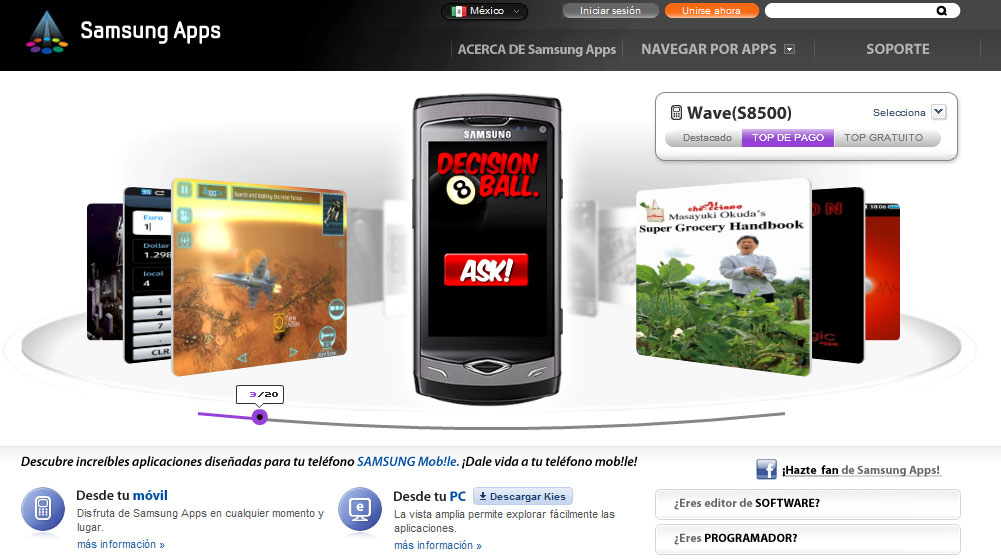
Zombie Eliminator & Real Decision Ball on bada

My Zombie Eliminator (first mobile game in 16 languages, available on Palm Pre & Pixi, Android & Samsung bada) was today on place 20. (out of near 1800) in 'top 50 paid apps' in Chinese Samsung Apps Store, 32. in Italian & Mexican, 44. in Australian and 46. in Turkish. I feel gently honored:).

And my other App, Real Decision Ball (also on Palm Pre & Pixi, Android & Samsung bada) is now number 3 in Mexican Market.

Tuesday, August 31, 2010

NodeKnockout - Massivetris

Try my first node.js app ever - created in 48h Massive Multiplayer Online Tetris. Choose from one of 72 avatars and play with others in realtime. It works best in Safari or Chrome, in Firefox WebSockets are emulated by Flash Plugin (awesome Socket.IO feature). There are couple of bugs I'm aware of, but it is possible to play and have some fun. If you enjoyed, don't forget to vote (button in right-top corner).
Direct links to the game: [Massivetris] and to the [Team Site].

And here is the source: [Massivetris]

Saturday, July 31, 2010

10K Apart competition

In the early '90, when I had my first contact with computers, I don't even heard about Cd-roms, or other freaky inventions like hard discs. I had 2 floppy stations, 3.5' and 5.25', with that 'bigger' (by size, no capacity) all the time busy with DOS disk, so everything I had was only 1.44MB. My favorite games then were Prince of Persia (yes, that one from top of this blog) and King's Quest (I finish it first time in my life after almost 18 years of playing, couple months ago on Sarien, online canvas versions of Sierra games).
Today I felt a gust of those days. 'An Event Apart' organized crazy web-app competition called 10K Apart with two main rules: total file size, including images, scripts and markup, must be under 10K and app must work in IE9, Firefox and WebKit browsers.
After about 8 hours of developing two games and bugfixing one annoying webportal simultaneously, let me introduce Stairs to heaven in 6,22KB.

Enjoy and don't forget to click '5 stars' on 10kA site:).

Tuesday, July 13, 2010

First touch with Palm Pre

My 'Zombie Eliminator' is now ready to download for your PalmPre phone in official Palm App Catalog. Twelve levels of pure fun served in sixteen languages. Check it:

Wednesday, May 5, 2010

Simple puzzle game

Internet is full of different programming frameworks. Nowadays you don't have to learn new language, you only need to know any friendly and easy to use framework and you can start your adventure with code.

I don't like that. I can't 'feel' the code when I use frameworks for everything. I got a feeling that it's no more mine - I just 'press a magic button' and some hard to understand and explain things happen. For sure - it's not serious to code huge project in pure code. But if it's your first contact with new programming language - try to explore it on your own. Try to understand what it's all about. And then feel free to use whatever you want - it's ok if you understand more or less what happens behind the scenes.

Today was my first serious attempt to create js game using something different than pure JavaScript. I choose jQuery because I made before a few projects using it. And here it is, a simple puzzle game like almost 10years old Clix. In few words, quoting www.javascriptgaming.com:

When you click a block (...) it and all neighbours that are the same color disappear. Gravity makes the blocks above fall down, creating new opportunities.

If a column is completely cleared, the remaining columns are moved closer together. When (...) the screen is all clear, the game is over. Points are awarded for clearing groups of blocks, the more blocks you remove in one click, the more points.


The only difference is that in my version there are new 'blocks' each 3 lvls. You have 11 levels of fun in FB version and unlimited in nonfacebook one (but there are only 5 types of 'mojito-blocks').


Try it on facebook (in Polish, click 'GRAJ' to play):
http://apps.facebook.com/modzajto/
or outside:
here.

Monday, April 19, 2010

Isometric Snake game for Facebook

During the weekend I went with my girlfriend to my countryside house. Anyway, I didn't want to waste my daily gamedeveloping time.
I created there simple snake game (days ago one of the most popular mobile game for Nokia cells) with isometric graphic. I modify sprites from one wikipedia graphic and use logic from my old Snake game.

Find VD SNAKE 3d on Facebook or simply try this link: http://apps.facebook.com/vd_snakeiso/. (My average result is 700points, what's yours:)?)
You can also become a fan of the game.

Monday, April 5, 2010

Eastern Compo 2010

It's almost tradition that during Eastern Holidays Warsztat members organize special edition of Compo (game developing competition, check). Randomly chosen topic of competition was "A game with particles-effect, Zombies, arrows and deadly spikes". Quite creative.

I tried to create Tower Defense Game with Zombies as creatures, particle-flame throwers and spike-guns as towers and arrows as obstacles. I use some old javascript particle effects and try even to build few fire-towers. Unfortunately JS and web browsers are not adapted to generate thousand of tiny objects. It worked fine with one tower, very bad with two of them, and with three haven't work at all. Because of that I decided that required 'particle effect' will be "Hell fire", shown on spawn place of Zombie creatures. The same situation was with spike/nail guns. So i change my mind and simply put spikes like arrows - on the ground as obstacles. It took me about 8 hours to design, code, prepare the graphics and test the game, so it is not finished at all.

Finally, except me, there was only one participant took part in Compo, so there was no results. If you are interested in my game, download it here: EasternCompo [290KB]
(Readme and gui are in polish, sorry).